
When I was writing my bachelor’s thesis over one and a half years ago, one thing I found really interesting, was finding out the different points of view on menstrual leave.
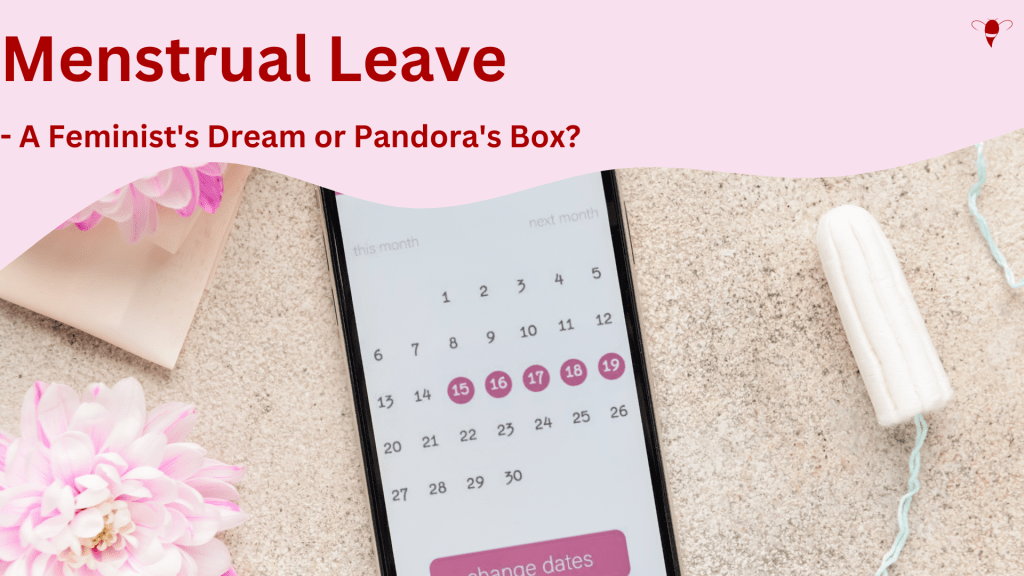
Menstrual leave — sometimes called period leave — is a topic that’s gaining attention around the world. Most recently when Spain guaranteed menstruating people, who suffer from severe pain during menstruation, up to three days paid leave. While some see it as a groundbreaking step toward gender equality in the workplace, others warn that it could unintentionally reinforce old stereotypes and set feminist’s back decades.
So, is menstrual leave really empowering or could it deepen inequality? Let’s look at what the research says.
Menstrual Leave as a Human Right
Many scholars view menstrual leave as more than just a workplace benefit, but a human right.
Researchers like Gupta & Bhakar (2023) and Bhagyamma (2023) argue that menstrual leave supports gender equity by allowing menstruating employees to care for their physical and mental health without stigma or guilt.
Studies show that menstrual leave can have a positive effect on mental well-being and productivity (Gupta & Bhakar, 2023). Interestingly, even male employees benefit from the more compassionate work culture, created by such policies.
At the UK-based company Coexist, for example, men reported feeling more freedom to adapt their work to their own well-being after the introduction of a menstrual leave policy (Owen, 2018). This suggests that flexibility and empathy in workplace culture uplift everyone and not only those who menstruate.
Freedom of Choice Is Key
In a survey of 109 people in Mumbai, Bhagat (2021) found that most respondents wanted the freedom to choose whether to take menstrual leave or not.
According to Hashimy (2022), equality doesn’t mean giving everyone the exact same conditions, but creating fair conditions based on individual needs. The argument “What do men get, if women get menstrual leave?” is being answered by this stance. Those who do not menstruate have no need for menstrual leave.
For Bhagyamma (2023), menstrual leave represents an opportunity for menstruating people to prioritize their health and well-being, while helping society recognize menstruation as a natural and valid part of life.
The Risk of Reinforcing Stigma
Still, not all researchers view menstrual leave through rose-colored glasses.
Some, like Levitt & Barnack-Tavlaris (2020) and King (2021), warn that such policies could accidentally frame menstruation as an illness, especially when it is processed through a sick leave systems.
This framing can increase period stigma and even lead to misconceptions about menstruating employees being “less capable” and inherently more expensive.
In fact, some survey participants described menstrual leave as sexist or as criticism of women’s efficiency at work (Bhagat, 2021). Others warned it might lead to menstrual shaming — subtle or open judgment around taking time off for menstrual health (King, 2021).
Collaboration Makes It Work
So what does a successful menstrual leave policy look like?
The answer seems to lie in collaboration.
The menstrual leave policy at Coexist was developed through a year-long conversation between management and primarily menstruating employees (Owen, 2018).
During that process, most employees expressed that they preferred flexible working options, such as remote work or adjusted schedules, over full days off.
Other suggestions included better working conditions, relaxation spaces, and improved sanitary facilities, all simple but powerful steps toward true workplace well-being for everyone, not just menstruation people.
As King (2021) points out, if workplaces became more flexible and fair for everyone, specific gender-based policies might not even be necessary.
Menstrual Leave: A Step Forward or a Step Back?
All studies agree on one thing: menstrual leave is a good, but a complex idea.
It lives in a delicate balance — somewhere between progress and potential pitfalls, empowerment and misunderstanding.
Whether menstrual leave helps achieve true equality or reinforces old myths depends on how we frame and implement it.
If designed collaboratively and communicated openly, it could become a symbol of progress and equality not a source of stigma.
Talking about menstrual leave means talking about trust, empathy, and equality. It’s about workplaces that understand real bodies and real people.
As long as the conversation stays open and inclusive, menstrual leave has the potential to normalise something that should never have been taboo in the first place: menstruation as a natural part of life and work.
Sources
Bhagat, Nayan. (2021). Understanding the need and Impact of Menstrual Leave. V-Search, 56-63.
Bhagyamma, Gopala. (2023). Exploring Menstrual Leave as a Human Right: Nurturing Gender Equality, Ile Human Rights Law Review, 2 (1) of 2023, Pg. 16-24, APIS – 3920-0010 | ISBN – 978-81-960677-2-4.
Gupta, Shorya., & Bhakar, Shilpa. (2023). ‘Menstrual Leave’ a Luxury or Nessacity – an Introduction. Business, Management and Economics Engineering, 21(1), 1142-1157. https://businessmanagementeconomics.org/pdf/2023/1142.pdf
Hashimy, Sayed. Q. (2022). Menstrual Leave Dissent and Stigma Labelling: A Comparative Legal Discourse. Issue 6 Int’l JL Mgmt. & Human., 5, 1270.
King, Sally. (2021). Menstrual Leave: Good Intention, Poor Solution. In: Hassard, J., Torres, L.D. (eds) Aligning Perspectives in Gender Mainstreaming. Aligning Perspectives on Health, Safety and Well-Being. Springer, Cham. https://doi.org/10.1007/978-3-030-53269-7_9
Levitt, Rachel. B., & Barnack-Tavlaris, Jessica. L. (2020). Addressing menstruation in the workplace: the menstrual leave debate. The Palgrave handbook of critical menstruation studies, 561-575.
Owen, Lara. (2018). Menstruation and humanistic management at work: The development and implementation of a menstrual workplace policy. J. Assoc. Manag. Educ. Dev, 25, 23-31.
 RedBee
Leave a comment